Difference Traditional / Sport

Traditional and sport Taekwondo


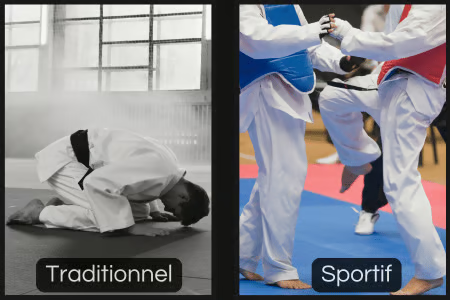
Two approaches. One same origin. A profoundly different vision of combat and practice.

The evolution of Taekwondo into a modern sport discipline has profoundly transformed its practice. Between martial tradition and competition, the objectives, methods, and even the understanding of combat differ.

Two approaches. One same origin. A profoundly different vision of practice.

Modern Taekwondo has evolved into a codified sport discipline while still preserving its martial roots.
Today, these two dimensions coexist… but they do not pursue the same objective.

In our Academy, we place strong emphasis on the martial dimension, while still recognizing the value of the sporting approach. Understanding the difference between the two helps better understand what we practice, why we practice it, and for what purpose.

Traditional martial art

  • Effectiveness in real situations
  • Overall development of the practitioner
  • Mastery of body and mind
  • Personal growth
  • Self-defense
  • Respect and values

Competition sport

  • Point scoring
  • Performance and strategy
  • Techniques optimized for scoring
  • Regulated framework
  • Use of electronic sensors
  • Measured performance
  • Competition
 

Sport taekwondo develops performance within a regulated framework.
Martial taekwondo focuses on effectiveness, self-mastery, and progression along the martial path.
Both approaches have their value, but they do not pursue the same objective.


A DIFFERENCE IN OBJECTIVE

Martial Taekwondo

Martial taekwondo primarily aims at the overall development of the practitioner.
It seeks to shape a person capable of developing:

  • correct technique
  • inner discipline
  • reaction ability
  • better control of body and mind
  • the ability to protect oneself in real situations

The goal is not only to succeed in an exercise or score a point. It is about building a more complete, more aware, and stronger practitioner.

Sport Taekwondo

Sport taekwondo pursues a different objective: performing within a defined competitive framework.
Training is focused on:

  • scoring points
  • speed of execution
  • explosiveness
  • tactical awareness
  • respect for the rules
  • optimization of actions that score points

This approach is legitimate within its framework, but it follows a different logic.


Martial conditioning

Martial conditioning develops reflexes focused on:

  • adaptation to any situation
  • distance, timing, and intention work
  • stress and unpredictability management
  • search for real impact
  • continuity of action

The training does not stop at the execution of a movement. It also includes:

  • positioning
  • posture
  • vision and awareness
  • breathing
  • mental resilience
  • the ability to remain clear-minded under pressure

Sport conditioning

Sport conditioning specializes the body for the competitive framework.
It develops:

  • techniques optimized for scoring
  • priority on timing and speed
  • strategies linked to scoring
  • adaptation to rules and electronic sensors
  • management of combat as a system

The practitioner becomes highly effective within a specific system.


A fundamental technical difference

Martial Taekwondo

The technical repertoire is broad. It may include:

  • high and low kicks
  • significant punching techniques
  • direct strikes
  • blocks
  • varied footwork and movement
  • self-defense training
  • control of the opponent
  • practical applications of forms

Technique is designed to be useful, not only spectacular.

Sport combat Taekwondo

Techniques are selected according to their competitive effectiveness.
Certain actions are favored because they score more points or adapt better to the electronic detection system.

This sometimes encourages:

  • fast kicking techniques
  • head touches
  • spinning techniques
  • opportunistic actions
  • an impact control different from real-life situations

Sport technical Taekwondo (poomsae)

Here, the logic is different once again.
The practitioner seeks precision, form, rhythm, aesthetics, balance, and expression. It is a demanding practice, yet still governed by judging criteria.


A different relationship to combat

Martial vision

In a martial approach, combat is not a game.
It implies:

  • real consequences
  • constant awareness
  • responsibility
  • a search for effectiveness without illusion

The practitioner learns that a poorly placed, hesitant, or superficial strike may solve nothing.

Sport vision

In competition, combat becomes a regulated confrontation. The objective is to win according to rules accepted by everyone.

This creates a different logic:

  • time management
  • score management
  • strategy management
  • working within the limits of the system

It is not wrong. It is simply something different.

The role of Poomsae in martial practice

Poomsae (forms) lies at the heart of traditional practice. 

It is not simply a choreography, but a codified set of techniques representing combat against several imaginary opponents.

It helps develop:

  • technical precision
  • coordination
  • power and control
  • understanding of combat
  • mental discipline

In a sporting approach, Poomsae becomes a competitive discipline, evaluated according to criteria such as aesthetics, rhythm, and precision.

In a martial approach, it remains above all a tool of transmission, allowing practitioners to integrate the fundamental principles of combat and preserve the essence of Taekwondo.


The question of protective gear and sensors

One of the major differences between the two approaches comes from technology and protective equipment.

In a sporting context

Electronic chest protectors, helmets, and detection systems have transformed the way people fight. They favor certain strikes, trajectories, and levels of intensity.

The practitioner therefore learns:

  • use of electronic chest protectors
  • impact detection systems
  • techniques sometimes adapted to the system
  • a logic of efficiency and scoring

In a martial context

The logic is the opposite.
The goal is not to have an action “validated,” but to produce a real effect.
Technique is therefore approached differently:

  • no technological assistance
  • search for real effectiveness
  • precision, structure, and intention
  • every technique must be applicable

The distortion between sport and reality

Combat as a game

In competition, the objective is to hit without being hit. This logic creates strategies that are effective for winning… but far from the reality of an actual confrontation.

The technological illusion

Electronic equipment favors certain light or specific strikes that would not necessarily be effective in a real situation.

The reality of combat

In a real situation, every strike matters. There are no weight categories, no rules, and no referees.


Our position: a martial practice above all

Martial Taekwondo is a path

The “Do” is more than just a word. 

Traditional Taekwondo goes beyond simple physical effectiveness. It is based on the pursuit of self-mastery, respect, and balance between body and mind.
It represents a path of transformation, a way of practicing that shapes character as much as the body.

The martial practitioner develops:

  • respect
  • humility
  • perseverance
  • self-control
  • a sense of effort
  • consistency between attitude and technique

Sport Taekwondo prioritizes performance

Sport performance can also develop valuable qualities: discipline, commitment, courage, and self-improvement.
But its primary goal remains success within the competitive framework.

When this logic takes over completely, the martial dimension can gradually fade away.


The relationship with the Master

In martial tradition, progression is also based on transmission.

The Master does not only transmit techniques, but also:

  • understanding
  • intention
  • consistency in practice

This relationship allows the practitioner to evolve beyond simple execution, involving trust, respect, and commitment. 


Why we prioritize the martial dimension

In our Academy, we choose to teach a Taekwondo focused on:

  • deep understanding of technique
  • discipline in learning
  • martial coherence
  • inner progression
  • realistic effectiveness
  • respect for the spirit of Taekwondo

This does not mean rejecting competition.
It simply means that, for us, Taekwondo cannot be reduced to a logic of points.
The limits of confusion between the two

Confusing sport practice with martial reality can lead to:

  • an illusion of effectiveness
  • partial conditioning
  • a loss of meaning
  • distance from self-defense

Why we prioritize the martial dimension

Why we prioritize the martial dimension

In our Academy, we choose to teach a Taekwondo focused on:

  • deep understanding of technique
  • discipline in learning
  • martial coherence
  • inner progression
  • realistic effectiveness
  • respect for the spirit of Taekwondo

This does not mean rejecting competition.
It simply means that, for us, Taekwondo cannot be reduced to a logic of points.


Aspect

Martial art

Sport

Objective

Self-defense / personal growth Scoring points

Techniques

Complete and varied Optimized for scoring

Rules

None (reality) Very strict

Mindset

Discipline and self-mastery Performance and competition

Conclusion

Sport Taekwondo and martial Taekwondo are not necessarily opposed to each other, but they should not be confused.

One focuses on performance within a competitive framework.
The other seeks to shape a complete practitioner — technically, mentally, and humanly.

The real question remains:

What are we truly seeking in the practice of Taekwondo?


Last edited: 13/05/2026