
Master Kim’s Vision
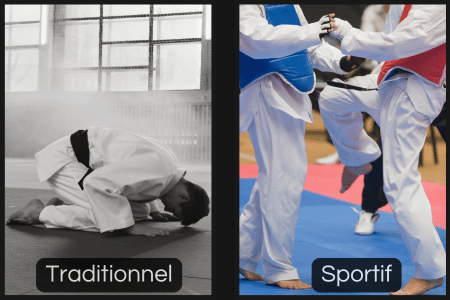
The growing gap between traditional martial practice and the modern evolution of Taekwondo as a sport is an undeniable reality.
These differences deeply affect the training of Taekwondo practitioners, their skills, and their understanding of what a martial art truly represents.
Conditioning: Martial Art vs. Competitive Sport
Traditional Martial Art
The conditioning of the practitioner focuses above all on real combat situations and the ability to react effectively in self-defense.
Every strike is taught with real intent — each movement must be executed with power, precision, and determination to neutralize a threat.
Training emphasizes body conditioning (flexibility, endurance, explosiveness), distance control, strike precision, and adaptability to unpredictable situations.
Learning also includes elements beyond combat, such as meditation, fear and stress management, and knowledge of vital points.
Modern Competitive Sport
In the modern sport, conditioning is focused on performance within a regulated environment, where the main goal is to score points.
This includes specialization in techniques that maximize scoring — mainly high or spinning kicks.
Strikes are often not delivered with full force, as the objective is to trigger the electronic sensors, not to cause real impact.
This creates a habit of light control, which may be problematic in real-life defense situations.
The use of electronic chest protectors has accentuated this tendency, making some powerful or realistic techniques ineffective if they do not register in the scoring system.
This conditioning moves practitioners further away from the reality of combat.
The Distortion Between Sport and Martial Reality
Sport as a Game
Competitive Taekwondo, with its strict rules, can sometimes resemble a game of “touch without being touched.”
This system pushes athletes to develop point-oriented strategies that don’t reflect real fighting conditions, where a weak strike would leave an opponent unaffected.
The Illusion of Technology
Modern technology, such as electronic scoring gear, deepens this distortion.
It rewards light or poorly targeted strikes that would be ineffective in real situations.
The absence of strong hand techniques in the scoring system limits technical versatility — a major flaw for real-life defense.
Disconnection from Reality
In real combat, every strike counts.
A weak or misplaced attack is meaningless against an aggressor.
There are no weight divisions or rank categories in real life.
Traditional martial arts teach practitioners to strike decisively and with purpose, to protect oneself or others — an aspect often missing in sport training.
The Martial Way: A Different Philosophy
Traditional martial arts go far beyond physical performance.
They embody a philosophy of life centered on respect, humility, and self-control.
This moral dimension is often absent from purely competitive environments, where victory and performance become the main goals.
By losing this essence, modern Taekwondo risks becoming a superficial practice, stripped of its deeper spiritual and educational content.
Main Differences Between Martial and Sport Taekwondo
Objectives and Philosophy
Martial Taekwondo
Focuses on self-defense, personal development, martial discipline, and the traditional roots of Korean martial arts.
The goal is to defend oneself effectively in real situations while embracing the Taekwondo values of discipline, respect, and self-control.
Sport Taekwondo – Sparring (Kyorugi)
Centered on competition and performance, especially in Olympic events.
The aim is to score points within strict rules.
Priority is given to speed, precision, and tactics rather than real-life defense.
Sport Taekwondo – Technical (Poomsae)
Focuses on performing forms (Poomsae) with power, accuracy, balance, and grace.
Competition emphasizes technical perfection and aesthetic presentation, not combat.
Techniques and Preparation
Martial Taekwondo
Includes a wide range of techniques — punches, low kicks, joint locks, throws, and targeted strikes to neutralize an opponent.
Training develops realistic reflexes and adaptability for self-defense.
Sport Taekwondo – Sparring (Kyorugi)
Techniques focus mainly on kicks above the belt, which score points.
Punches are allowed only to the torso.
Head kicks and spinning techniques earn higher scores.
Sport Taekwondo – Technical (Poomsae)
Uses only the techniques required for forms, focusing on precision and execution.
Combat and self-defense are not part of this discipline.
Rules and Restrictions
Martial Taekwondo
No fixed rules — techniques prohibited in sport (such as low kicks, joint locks, or groin strikes) may be practiced for realistic self-defense.
Sport Taekwondo – Sparring (Kyorugi)
Highly regulated combat.
For example, strikes below the belt or throws are not allowed.
Athletes must wear full protective gear (chest guard, helmet, etc.).
Sport Taekwondo – Technical (Poomsae)
Each form is strictly codified and judged based on accuracy, rhythm, and energy expression.
Training Methods
Martial Taekwondo
Training is comprehensive and balanced, including combat, self-defense, forms (Poomsae), and mental discipline (Do).
Sport Taekwondo – Sparring (Kyorugi)
Training focuses on physical conditioning, speed, and precision for competitive success.
Athletes train specifically to optimize their performance in matches.
Sport Taekwondo – Technical (Poomsae)
Training is highly technical and repetitive, aiming for visual perfection and maximum scoring.
Combat and self-defense are not part of the preparation.
Spirit and Attitude
Martial Taekwondo
Centers on personal growth, ethics, and self-mastery.
It is viewed as a lifelong path — “the Do” — toward harmony between body and mind.
Sport Taekwondo – Sparring (Kyorugi)
Main focus is competitive achievement and performance.
Traditional martial values are sometimes less emphasized.
Sport Taekwondo – Technical (Poomsae)
Emphasizes aesthetic mastery and technical excellence over combat application.
In Summary
Martial Taekwondo focuses on tradition, self-defense, and personal development — a complete martial practice.
Sport Taekwondo, on the other hand, emphasizes competition and performance within a regulated framework, whether in sparring (Kyorugi) or technical forms (Poomsae).
BACK
Last edited: 12/12/2025